The Lamb of God and Ancient Magic
In The Lion, The Witch, and the Wardrobe, there is a scene where the evil witch demands the soul of a young boy. Edmund has committed treason, and, by the ancient laws of justice, his sinful soul belongs to the witch.
But, to the horror and despair of the good creatures who are watching, Aslan offers himself as a substitute sacrifice. The witch, who knows that Aslan is her ultimate enemy, gladly accepts the exchange. Aslan is bound, shaved, humiliated.
If you would ever like to meditate on a fresh take on Good Friday and Easter, maybe consider these last three or four chapters of The Lion, The Witch, and the Wardrobe. On the equivalent of Easter morning, Aslan greets two young girls and explains the rational for his sacrifice: “though the Witch knew the Deep Magic [the logic of justice, the law that entitled her to the sinner’s soul], there is a deeper magic still which she did not know. Her knowledge goes back only to the dawn of Time. But if she could have looked a little further back, into the stillness and darkness before Time dawned, she would have read there a different incantation.”
Aslan, of course, had been present in the stillness before Time. He was the author of this different incantation, this most ancient of all songs. His sacrifice and resurrection revealed the deepest truth of eternity, “that when a willing victim who had committed no treachery was killed in a traitor’s stead…Death itself would start working backwards.”
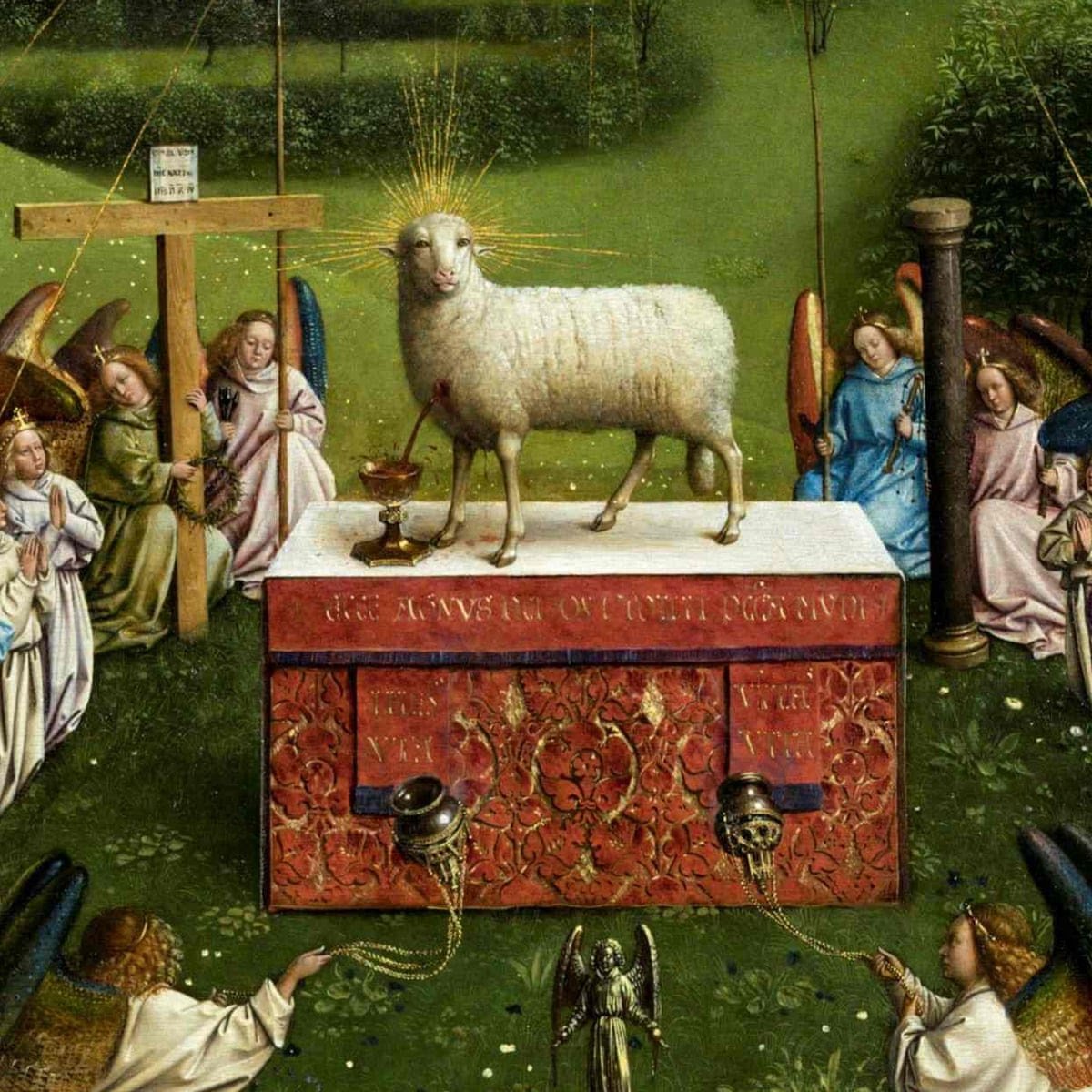
Friends, in today’s Gospel, when John the Baptist sees Jesus coming towards him and says “Behold, the Lamb of God, who takes away the sin of the world,” he is recollecting this deeper magic, the primal sacrifice. Think of what a “lamb” meant in scripture, to the Israelites listening to John:
In Genesis 22, God comes to Abraham and invites him to sacrifice Isaac, his only son. Can you trust me with everything, God is asking Abraham, can you trust all your dreams, all your future plans to me? Abraham climbs the mountain with Isaac, and Isaac asks “father, where is the lamb for our sacrifice?” And Abraham replies “The Lord will provide.” And at the top of the mountain, at the moment of truth, indeed, Abraham and Isaac find a ram in the thicket.
And in Exodus 12, the night before God leads Israel out of Egypt, Moses tells the people to select a spotless lamb, to prepare the Passover meal, and to smear the blood on the door posts, as a sign that this household belongs to Israel, the covenant people, and that the angel of death should pass them by.
Thus when John the Baptist says “Behold, the Lamb of God,” he is recollecting these and other Old Testament lambs, a lineage of mystery, blood, and sacrifice. When we, in every Eucharistic prayer, profess to “behold the lamb of God,” we are opening our selves to these ancient depths, exposing our hearts to the love that makes death flow backwards.
We do not understand it. The Eucharist is a moment when eternity pierces this world. It is the fundamental reality beyond our mortal ken. But we at least perceive that this mystery is deeply, deeply good, and our lives depend upon aligning our selves with it.
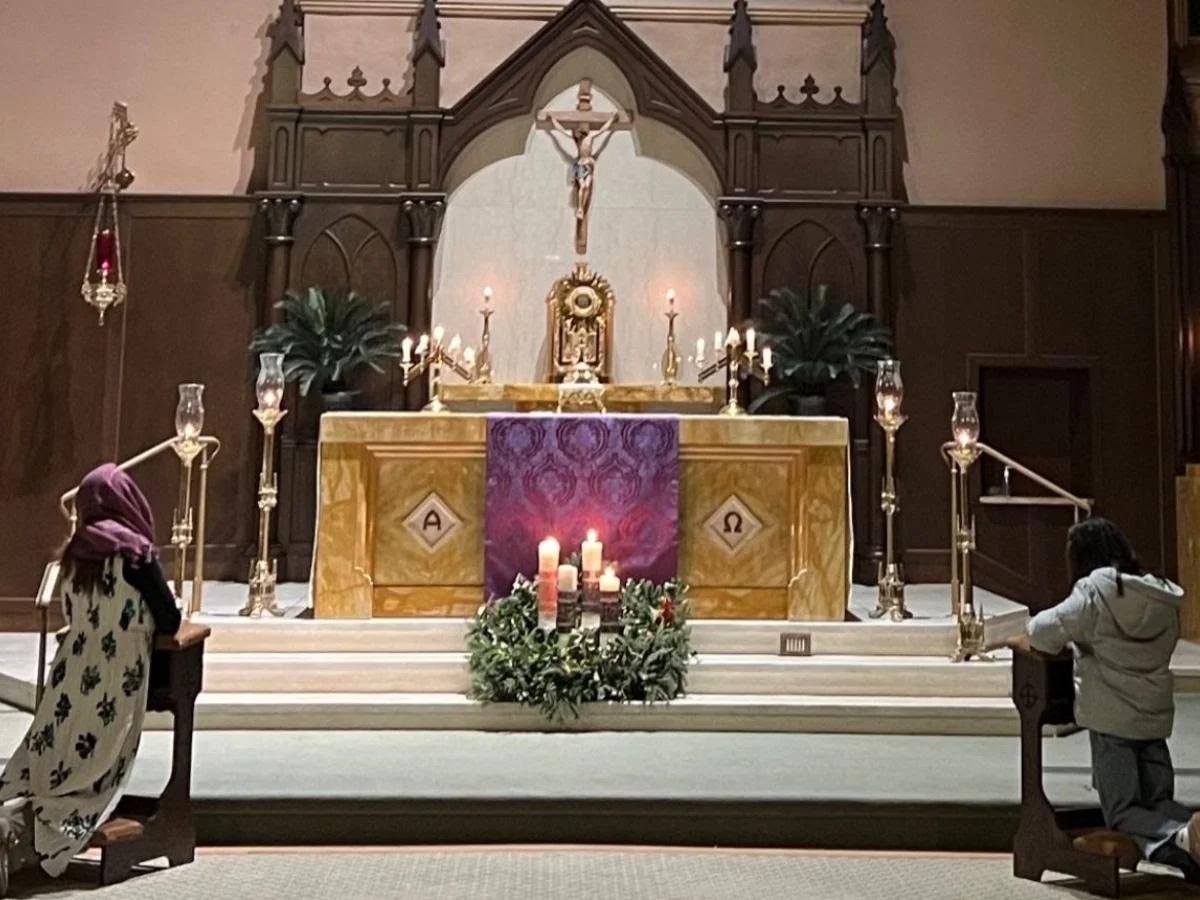
A couple of weeks ago, my parish's youth group planned a night of Eucharistic adoration. A good portion of that group are Martin Saints students. That night the teens arranged the church in near darkness, save one light aimed toward the altar. The altar itself was surrounded by and covered in candles, and the Eucharist was exposed in the center. The chants and hymns that the teens chose were in Latin, a choice that I think they made in order to recollect something ancient and primal. And they knelt before the Eucharist, in the darkness, some of them here on the carpet in front of the altar, for long extended silences.
This desire to draw near to the eternal mysteries, this desire to be near the Eucharist in a way that puts us close to sacred goodness, is a longing that I encounter again and again in my work with high school students.
Call it mysticism if you like, but I think it’s a very practical, very necessary spirituality that prepares us to be leaven in this day and age. This spirituality forms our conscience with the deep patience of eternity.
In my late 20’s, I was working for a television news program on PBS, and we interviewed Desmond Tutu, the late Anglican archbishop who won the Nobel Peace price not only for helping to overthrow apartheid in South Africa, but also for leading their truth and reconciliation commission. I mention him because whatever else we might say about his complicated legacy, nobody would accuse him of withdrawing from the world – he was a quintessential activist. And I will never forget how this Christian activist described his prayer routine:
"When I get up in the morning, I try to spend as much time as I can…being quiet in the presence of this love. It’s like I’m sitting in front of a warm fire on a cold day. I don’t have to do anything. The fire warms me. All I have to do is be there, in front of the fire. And, after a while…the qualities of the fire change me, so I have the warmth of the fire, I may have the warmth of the fire. And it is so awesome, with me and God. I just have to be there, quiet."
Whether we are an activist or a mystic, whether we are a teen kneeling before the altar by candlelight or perhaps an elderly person in a hospital bed, I believe we all most deeply long for the same thing: to be warmed by holy fire. Our hearts are restless, and we might not all always realize what we're restless for. But behold the wild goodness from the dawn of time. Behold the sacrificial love that renews and animates the deepest magic of creation. Behold the sacrificial lamb of God.
All of the church’s sacraments and devotions – the Mass, the rosary, adoration, you name it – we can think of them as different ways of drawing near to the ancient fire, warming our hearts, enabling us to live that same sacrificial love in our relationships and in all circumstances.
Let us now celebrate this Eucharist, and present ourselves to eternity. Let us recapitulate the sacrifice. "When we eat this Bread and drink this Cup, we proclaim your saving death, O Lord, until you come again."