From Stars to Sacraments

Our first reading tells us to “seek the Lord while he may be found, call him while he is near.” Our Psalm promises “the Lord is near to all who call upon him.”
How do we do this? How do we seek, find, and experience this nearness?
The good news is that God is always present, close at hand. The bad news is that for most of us, because of the way we live, we're not always tuned in.
What can we do? How can we train our attention to notice the most really real thing there is, the presence of God.
This is why, each year at Martin Saints, we start the school year with a camping trip. The whole school goes in order to lay some important foundations for the rest of the year.
We go to make friends and relax. We go so that the students can notice how our life together changes when we leave our phones behind. We go to experience God’s presence in nature.
These things are all related. When we go canoeing on the Delaware river, when the light shimmers on the water, when the water feels cool and clean, when the wind blows through the trees, when the bald eagle soars overhead – it helps for opening our hearts.
And if we will grant that God speaks through creation’s beauty, then it’s not a big step to explain the Catholic idea of sacraments. Our creator speaks through everything he has made – not only through the wilderness, but through our bodies, through bread and wine, oil and water, the laying on of hands. God has a presence, and he’s continually offering himself. We can seek and find God by putting ourselves in a sacramental way of seeing all of life.
Another vignette from our most recent trip, just two weeks ago, came at a campfire under the night sky. We talked about how God is like the Milky Way galaxy. The Milky Way is always out there. Human beings can’t change it. It doesn’t go away. The Milky Way abides. The twist, of course, is that most of us can’t see it most of the time. Our ordinary lifestyle – the hustle and bustle, the busy-ness, the light pollution – obscures our view. If you want to see the Milky Way these days, you have to be intentional about it. You’ve got to take steps to put yourself in a place where skies are dark, like maybe going camping or to a rural area.
I often think about how, until maybe our grandparents or great-grandparents generation, it was normal to see the Milky Way almost every night. As long as it wasn’t cloudy or a super bright full moon, if you stepped outside after dark, you could routinely look up and see it. These last couple generations – we, who go months if not years between Milky Way sightings - we’re the unusual ones. I wonder how that changes our sense for the sacred, our awareness of the supernatural. We are, in this significant way, less well-informed than our recent ancestors.
But back to the scriptures. We’re trying to seek the Lord while he is near, call upon him while he may be found. What is the spiritual equivalent of getting away from the light pollution? How can we train our attention to notice the presence of God, who, like the Milky Way, is always there?
Putting the phone down and being in nature is part of it. Participating in the Church’s sacramental life is also baseline. Daily prayer, weekly Mass, and monthly confession – if we do those things faithfully, we will make progress. Guaranteed. This rhythm of spiritual life takes a little discipline, but it’s not an esoteric secret.
But today’s Gospel points to one other ingredient, something deep, something that can be harder to teach.
In today’s parable, God, the landowner, goes out five times – at dawn, 9am, noon, 3pm, and finally at 5pm – to find laborers for his vineyard. God keeps showing up, inviting us, persistently. The challenge is: who are we in this parable? Are we the early morning worker, or are we the late 5pm crew?
The parable climaxes early in the evening, when the early workers receive their full day’s wage as agreed. But the landowner is generous, and the latecomers also receive a full day’s wage. The 5pm guys are ecstatic. But the earlier 9am types grumble, because it doesn’t feel fair. The landowner replies: why are you angry if I am generous?
The parable is asking: what is the status of our hearts? The parable is asking: do we go through life as the resentful, score-keeping worker, or are we the grateful 5pm’er? Who is more aware of the presence and nearness of God?
More often than I’d like to admit, I am a 9am guy. It’s like I have a little spiritual accountant inside, jealously maintaining a balance sheet of who is up and who is down, always ready to cite the ledger and explain why my sin isn’t really so bad, and why I deserve more than I am getting. Bargaining like that is the 9am way.
But if we want peace – if we want to practice the presence of God, if any of us want to seek and find the Lord - then we all need to trim the ego. We need to become like astonished, surprised, grateful 5pm’ers. The 5pm’er knows that whatever glimpses he has had of God’s goodness, truth, beauty, forgiveness and mercy – these are gifts from above, unearned – and these gifts can only be received as gifts. Bargaining, getting angry, jockeying for position – this egoism takes what should be a gift and turns it into an entitlement.
Egoism is like light pollution blocking the Milky Way. A possessive heart blocks our view of reality.
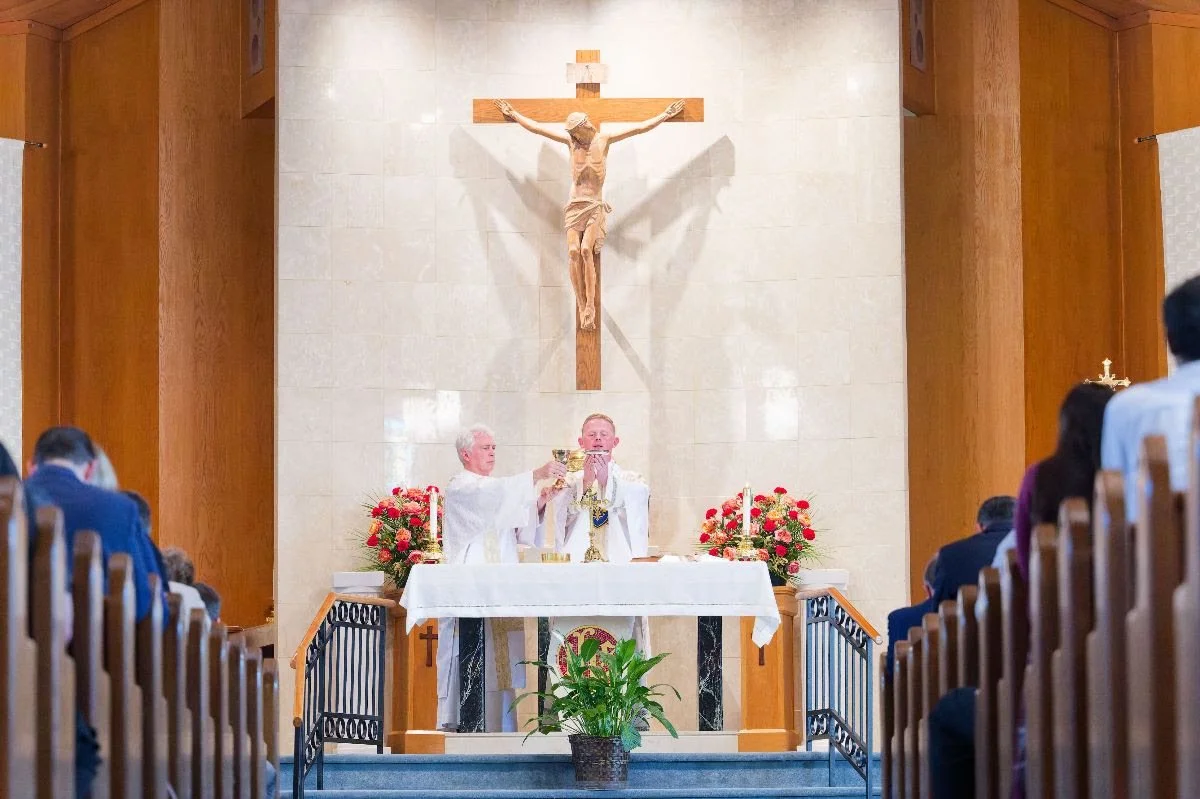
The good news is that we have this altar, the Mass, the place where we acknowledge that in reality, we’re all 5pm’ers in God’s vineyard, sinners reliant on his mercy. This altar is where we place our burdens, and sacrifice our resentments. The altar is where we confess that everything good is a gift. When we’re regular at the altar, we’re training our attention to notice the reality all around us, all the time. Amen.