The Dickersons, Marriage Theology, and Léonie Martin
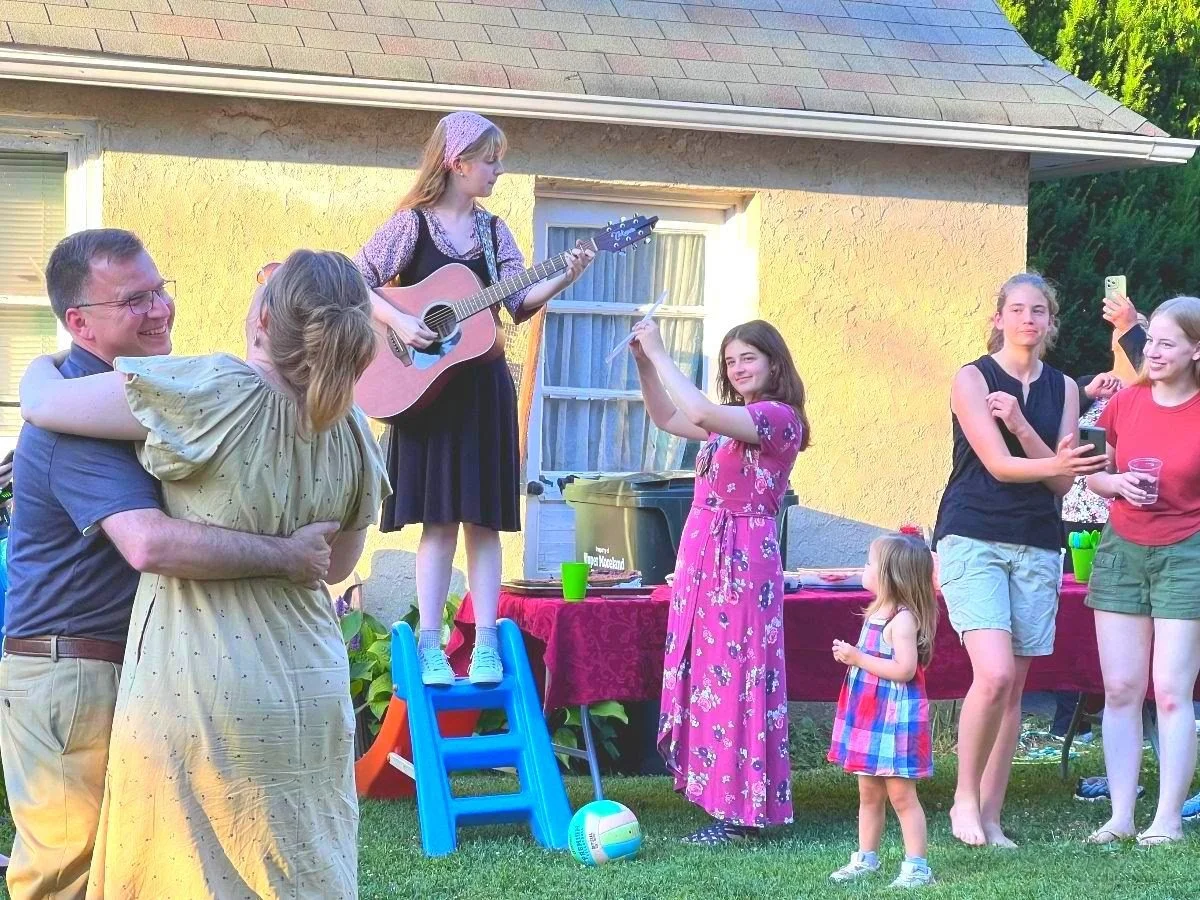
That is the face of a blessed man. That is woman tossing her head to the sky, abandoned to the moment, because she is in the right place. "The Glory of God is man fully alive!"
Yesterday our beloved headmaster and his beautiful wife celebrated their 25th wedding anniversary. Congratulations, Adam and Sarah! Their seven children threw a party for them on a glorious summer evening. Earlier in the day, we had a small Mass to mark the occasion at their neighborhood parish church. Below is Deacon's homily about Adam and Sarah, God's love for us all, one of the Martin family sisters, and how to live better.
*
If you’ve ever been on an email chain that Adam started - originating from his personal address book, probably an email to plan something Martin Saints-y - and if this email chain happened to include Sarah too, then you’ve perhaps noticed in the little address bar at the top, that when he wants to email his wife, he refers to her as “Mi Principessa.”
Awww….
Originally, I don’t know if he knew that his emails revealed his nicknames, but since I kidded him about it a while ago, that cat’s out of the bag.
Anyway, when Sarah replies, she is unabashed, and she’s likely to refer to him as “My Handsome.”
Awww…
Anyway, after 25 years - Mi Principessa, My Handsome - the sap still flows strong with you! Congratulations! Your family and friends here today - we’re just like the guests at the wedding feast in Cana. We’re grateful guests, honored and delighted to share in your joy. Thank you for including us!
And this sap, this romantic energy, that still flows between you - it shows why the Song of Songs is such an appropriate first reading.
Scholars say that from the time of Origen - the great second century theologian - up through Saint John of the Cross, the sixteenth century Carmelite mystic - we have more homilies preserved about the Song of Songs than any other book of the Bible. In other words, just reviewing the written records, more written homilies about the Song of Songs were preserved over the ages, compared to any other book of the Bible.
The medieval mind loved the Song, and its erotic love poetry, as an allegory about God’s love for Israel, for the Church, and for each individual soul. Saint Bernard of Clairvaux, the twelfth century Cistercian, wrote close to 90 homilies about the Song. He intended to write one homily about each verse, but he never got past the first half dozen or so. These homilies are easily available in translation if you ever want to give them a try. Bernard takes seven homilies just to work through the Song’s opening phrase “Let him kiss me with the kiss of his mouth.” The mystics love the Song because they want to make a point about how God loves us, with great ravishing passion.
And so, Mi Pricipessa…My Handsome…you raise the question: what diminutive nicknames might God have for each of us? Perhaps he might call me “my little jelly bellied deacon." But seriously. It’s an interesting question to pray over and contemplate. If God was going to give each one of us a diminutive nickname, something that captured his passion for each one of us as an individual, what might it be?
Adam and Sarah, like the guests in Cana, part of the reason we’re grateful to be your friends at your feast is because through you we have this view into these deep mysteries. You have lived your romantic love in a way that is a window transparent to God. Your marriage is indeed a sacrament, a missionary epistle, pointing to the love affair that we’re all seeking to have with God.
Of course, the Song of Songs is not the only reason why Catholics perceive marriage to be a sacrament. Marriage works as a metaphor for God’s love not only because it is erotic, but also because it is a covenant, an unbreakable bond for richer and poorer, sickness and health, better and for worse, in good times and bad. As you know, in Isaiah and Ezekiel, in Hosea and Jeremiah, Yahweh sticks with Israel even when Israel sins and breaks His heart. God’s erotic bond with his people is not a temporary, fickle, fading, contingent liaison. God's love is costly, sacrificial, and tenacious. God doesn’t abandon Israel when the going gets tough. God doesn’t abandon Israel when he thinks that the Egyptians or the Philistines have a more attractive lustre.
And so Adam and Sarah’s marriage is a sacrament for us all in this other way. They have stuck with it, for better and worse, richer and poorer, good times and bad. It takes real skills to do that for 25 years. Our second reading from first Corinthians bears witness to these skills. “Love is patient, love is kind…it does not seek its own interest, it is not quick-tempered, it does not brood over injury…but rejoices with the truth.” On our worst days, who among us could read this passage and not want to go to confession? But on our best days…and in particular, when we think about the covenant that holds Adam and Sarah, do we not admire and seek these virtues, this “more excellent way”? Do we not know that these are the skills that keep a covenant alive?
As anyone who has ever been a member of a family knows, when we are struggling with patience, kindness, and temper…when are trying not to brood over injury…a true inner asceticism is required. Marriage and family struggles usually require an inner motion of soul, a hidden dying to self, a lonely interior crucifixion that nobody else can see, but which we must choose, in order to follow the Lord and enable communion. Sin - impatience, rivalry, selfishness, lust, anger, self-pity - the devil wants these things to become habits, in order to sow division in our marriages and in our families. But that inner conversion, that interior clinging to the cross, that lonely commitment to do our best to mirror God’s fidelity to Israel in the way we love - these grace-fueled choices build communion, enabling grace to compound and layer blessing on top of blessing.
Adam said something the other day in a Martin Saints faculty meeting. Referring to his own experience of being a father, he said “the days can be long but the years are short.” I took him to mean that on some days in marriage and family, life can be a trial. We get tired. We have to press on anyway. Virtue is tested in the stress. But we do it. And then, lo and behold, the years have become short. The years appear short because we look back in gratitude for all the grace heaped on top of grace. It was there all along, in good times and bad, sickness and health, etc., whenever we chose virtue, whenever we loved like God does, not only romantically, but also in a covenant.
And when we describe divine love like this - when we try and paint the picture of a love that is passionate and breathless, but also chastened by humility and the way of the cross, a love that is tenacious even in the face of human weakness - we are of course describing the love of St. Thérèse of Lisieux and her famous “Little Way.” The Little Flower, one of the patrons of our school, is a living presence in our lives in no small part because Adam and Sarah chose to name a school after her family, and introduce her to all of us.
Today is the feast day of Thérèse’s sister, Servant of God Léonie Martin, whose cause for beautification and canonization is progressing. What a fantastic and appropriate date for your wedding anniversary. As far as I’m concerned, the skills and virtues that make a celibate nun radiant with holiness, and the skills and virtues that make a marriage successful and lasting, are more or less the same skills. It’s the same interior motion of soul and heart, the same willingness to yield our suffering without resentment, the same tracing of a deeper more mysterious love. It's the same matter of living generously, despite and because of the same interior longing that can sometimes be temporarily slaked in this life, but only finally consummated in the next one.
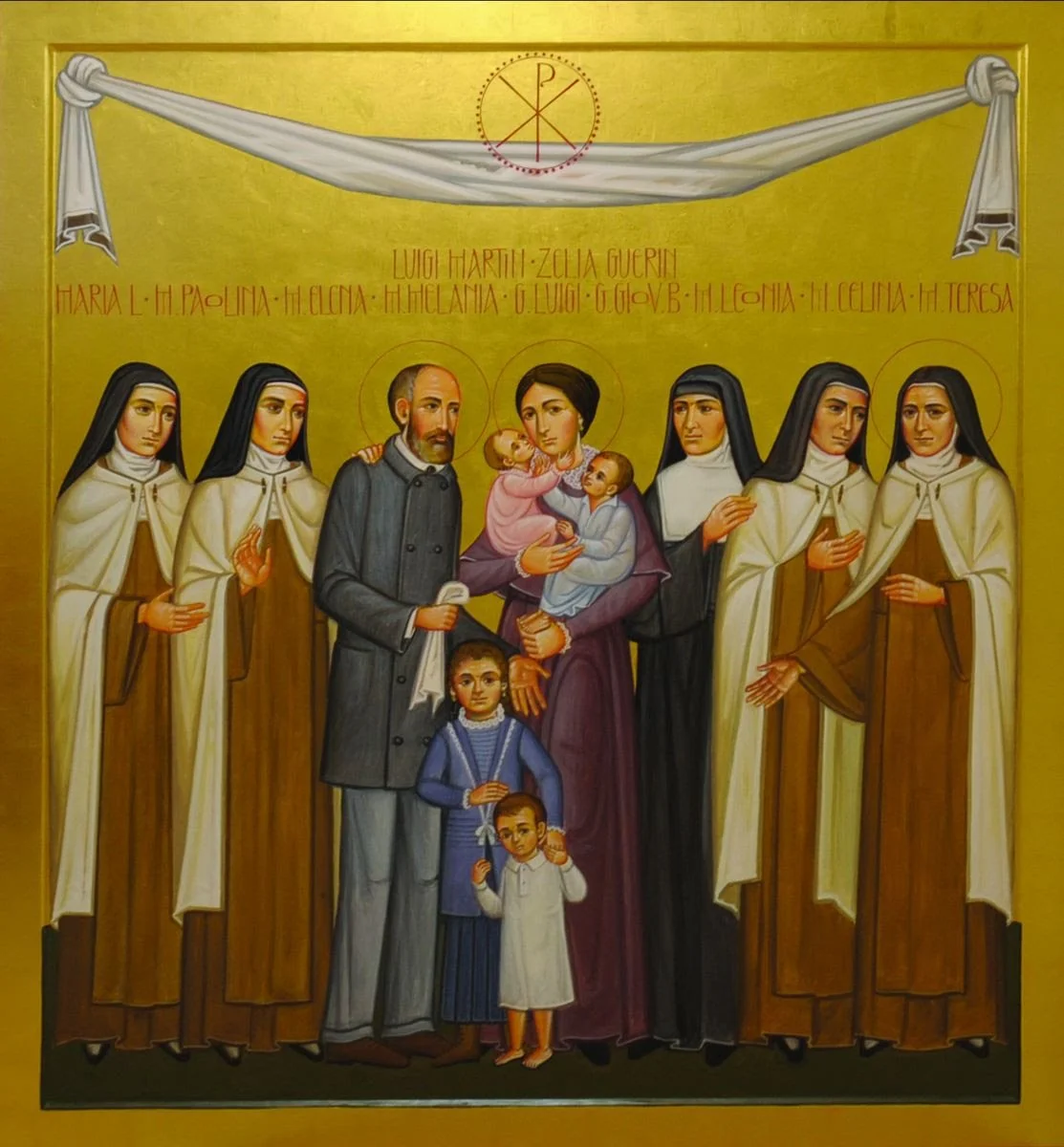
Léonie suffered from terribly painful eczema early in her life, which I think recurred often, along with measles and whooping cough. Her family governess abused her psychologically and physically. Léonie had violent emotional outbursts during her school years, probably suffering from undiagnosed ADHD or equivalent, and was expelled from several boarding schools. Her mother died when she was 13 years old, and her father’s mental illness deepened until it required his hospitalization. People told her that she was not as pretty or talented as her sisters. As a young adult, she tried three times to enter a convent, and, due to her temperament and weakness, was either rejected or dropped out, before she finally, on the fourth try at age 36, successfully joined the Sisters of the Visitation. When we gaze upon the Martin saints family icon, Léonie is the one in the black habit, the sister who survived to become a nun but joined the Visitation Sisters, rather than the Carmelites.
The point is, Léonie had so many excellent excuses for resentment or despair. But she kept going anyway. When her sister Thérèse died, and Léonie was able to read about the Little Way in Thérèse’s memoir Story of a Soul, that was the decisive moment. She wrote a letter to her surviving sisters, saying “I want to be so little that Jesus is forced to keep me in his arms.” Léonie became the first living disciple of the Little Way, abandoning herself to divine providence, all the more credibly and impressively because of her interior decision not to yield to temptation and become a prisoner of her grievances. She lived roughly 40 years more from that moment, becoming a radiant and integrated personality.
Mi Principessa, My Handsome - your lives testify that when we follow the Little Way, the days can be long, but the years end up being short. You know and you witness to the fact that when we follow the Little Way, although we may not feel it in the moment of trial, in truth nothing is denied to us, everything important is given us. To those who are lonely, God offers his eros, his diminutive nicknames. To those who are struggling, God points us to the more excellent way, the virtues of 1 Corinthians 13. To us, Adam and Sarah, you have given this witness. You have stepped forward into the Way. We thank you for sharing the Martin saints with us. We thank you for sharing your marriage. Indeed, having taught some of them, we thank you for sharing the fruits of your marriage with us, these wonderful children.
For all that has been - we thank you! For all that has yet to be, to come our way - we say “yes please, amen!”