Love Your Family More Than Jesus?
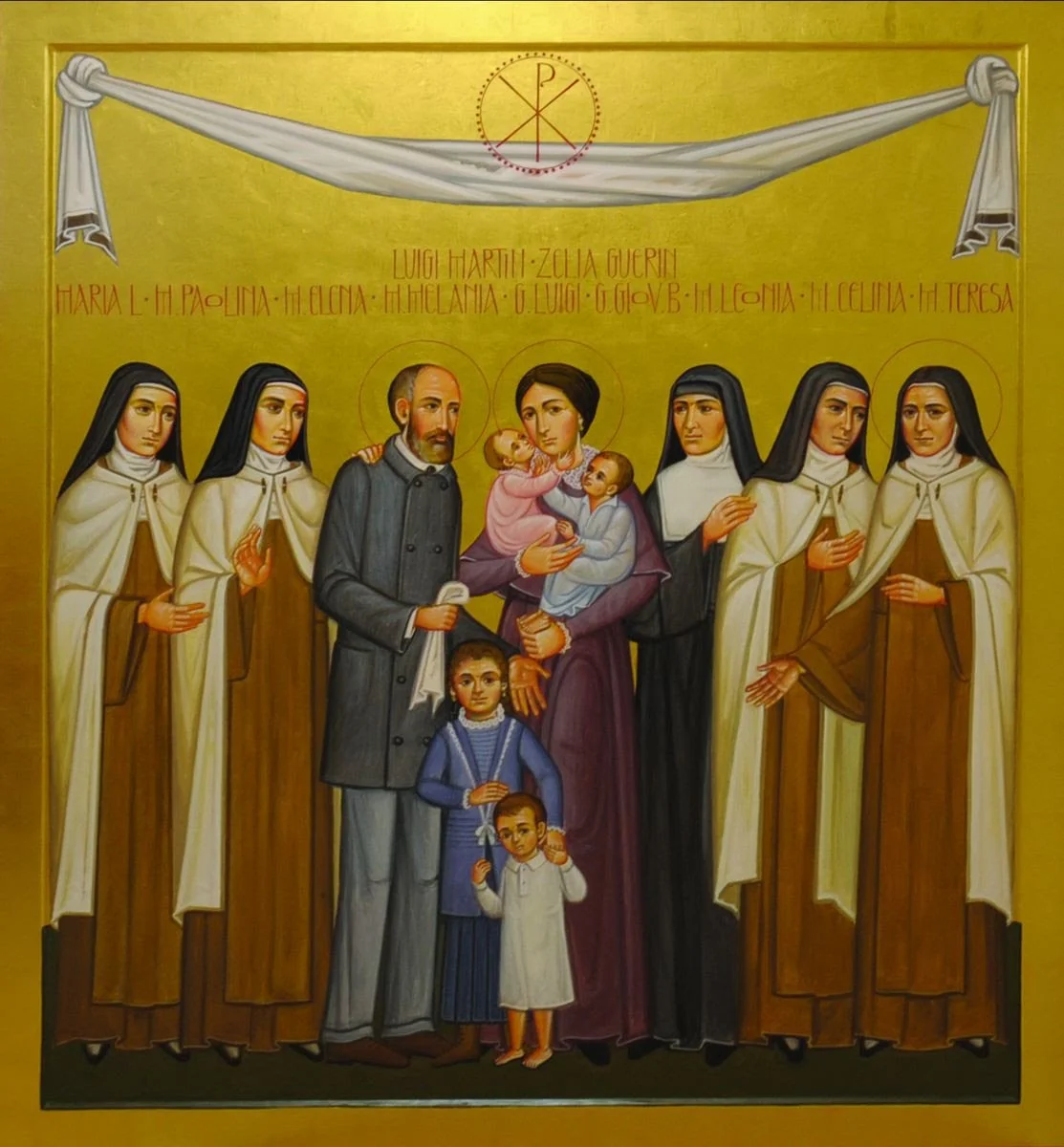
A family who succeeded as a family because they put Jesus first.
“Jesus said to his apostles, ‘Whoever loves father or mother more than me is not worthy of me, and whoever loves son or daughter more than me is not worthy of me.’”
The parallel version in Luke puts it even more starkly: “If anyone comes to me and does not hate his father and mother and wife and children and brothers and sisters…he cannot be my disciple.”
How could Jesus say such things? These have been hard verses for me to hear. As a married father of four daughters, family life is one my treasured blessings and consolations. Even more on the nose, as many of you know, my mother died on Memorial Day last month. (Thank you to everyone who sent me notes and Mass cards.) I loved my mom. Today after Mass, I will drive back to Baltimore to be with my 90 year old, grieving dad. I will do that because I love him too.
So what does Jesus mean? Am I wrong to love my parents? Jesus and his Church have enough hard sayings that I have a well-worn path when I encounter them. Whenever Christ or His Church say something that I don’t want to hear, I remind myself that he loves me. I try to sit with the hard thing from that perspective, without watering it down or waving it away, trusting that somehow, he is trying to love me even through this hard saying. That he can change me in a way that I need to be changed, if I can give myself over to him.
I sit. I wrestle. I read. I talk to trusted, mature spiritual friends. And most of all, I pray. I try to pour out my heart as honestly as I can, censoring nothing. I seek context, not in order to dilute, but in order to understand.
Today’s context: our faith actually has a lot to say about how wonderful the family can be. The family is where most of us meet Jesus for the first time. “Honor your father and mother” is still the fourth commandment. From St. John Chrysostom to the Second Vatican Council, our tradition refers to the family as the “domestic church.” John Paul II’s encyclical Familiaris consortio – on the fellowship of the family – is one of the great modern encyclicals. Ten years ago, when Pope Francis came to Philadelphia, it was for the World Meeting of Families. There was a short, very readable catechism at the time about the family and marriage – which you can still find on Amazon - and it was called Love is Our Mission: the family fully alive.
All of these documents are also pretty savvy about how family life can go sidewise and get dark. But they are all united and have the same bottom line. Whatever he might be saying in today’s Gospel, we cannot say that Jesus is against family tenderness. The family should be the first school of love. That is fundamental Catholic teaching.
As far as I know, there was only once when I really deeply disappointed my parents. That is when I converted to Catholicism. I remember the first time I ever mentioned to them that I was considering it. It was 1994. I was nearly 25, studying abroad, far from home. I had attended Eucharistic adoration and Benediction for the first time. I was blown away by the reverence, the intimate attention given to the supernatural presence of Jesus. I longed to participate in the Eucharist, to be joined to whatever was happening on that altar. I started to read church history, to attend liturgies, to kneel and pray.
My parents could not understand it. I told them that I was just doing what they had taught me to do – to seek Jesus and not count the cost, one step at a time, wherever it might take me. They did not see it that way. We argued. There were raised voices. It set me back and took me over a decade from that moment to actually work up the courage and become a Catholic. Along the way, it cost me some friends. It took me out of my professional network and set back my career. But once I had that longing for the Eucharist in my heart, I could not shake it, and everything else in life had to be change in order to make the Eucharist the center of my life.
In time, my family reconciled. My parents never stopped loving me, my wife, and their granddaughters. But there was no guarantee at the time how it would unfold, and I doubt my parents ever really understood the call I felt.
I also wonder if my experience suggests why so many of us hold back from the faith. After all, why did I procrastinate for a decade? What was I afraid of? I loved and love my parents. Taking Catholicism meant risking that. I think it is common to fear that following Jesus will cost us something. Whether we are cradle Catholics wondering whether to go deep with our faith, or outsiders encountering the faith for the first time - wherever we are on that spectrum, we correctly sense that if we give ourselves fully to the Lord, our lives will change.
Jesus wants to touch every part of us. The pearl of great price might be sexuality, bank accounts, careers, friends, politics, ethics. Our tribe. Our respectability and social standing. Our family and even our parents. If he is who he said he was, then everything is on the line. If we love something more than him, if we seek security in some other strategy, then that worldly thing is our real god. That thing is an idol. Few of us can easily yield what is precious to us, where we think our security lies. The Church said "no" to my autonomy, and I needed that discipline. Neither Gollum nor Frodo were able to give up the ring voluntarily. Conversion is not a one-and-done event for anyone; the oldest disciple, as well as the Johnny-come-latelies like me, must daily pray like a beginner and take up the cross afresh, offering up what is precious.
I believe this is what Jesus is getting at when he tells us to hate our families: to love him first and foremost. We read elsewhere in the New Testament that you must lose your life in order to save it. Jesus says that the first shall be last, and the last shall be first. John the Baptist says he must increase, but I must decrease. St. Paul says when I am weak, then I am strong.
Modern life rejects Christian paradox. Modern life encourages self-assertion and entitlement. And yet modern life has its own paradoxes, for despite the pursuit of happiness, all around us are increased levels of anxiety and unhappiness. The other day in the car, I turned on sports radio, and they were discussing which boat and what kind of plane they’d buy if they had major league money. I changed to a news station, and it was yet another politically correct story about sexual self-expression and self-absorption. One of these radio station tilts conservative and the other tilts liberal. Together they illustrate the self-centered atmosphere we breathe, subtly catechizing our imaginations, shaping our assumptions about happiness. And yet our culture is more and more unhappy, spinning out of control.
Yet we can choose which paradoxes we embrace. GK Chesterton wrote, “How much larger your life would be if your self could become smaller…. You would break out of this tiny and tawdry theater in which your own little plot is always being played, and you would find yourself under a freer sky.”
The good news is that when we give our lives away – when we subordinate everything to Jesus, even good things like family – everything important is given back to us. There is nothing to fear. He loves us more than we can imagine, and he wants to live in our hearts to make us more fully alive than we can imagine. A saint is someone who has trusted in this paradox, who has made the internal decision, the invisible interior recommitment.
The fruit is radiant superpowers, a hidden anchor in Christ, a place to stand outside the crowd, a place of freedom from fear, a strength to endure the unendurable.
“Thy will be done,” we shall shortly pray, and it is a phrase we pray when we are trying to offer everything to him. That longing we feel for communion, that desire for his Presence on this altar – that longing in the heart is a hint that we were made for something beyond our present circumstances, something grand and beautiful, a restlessness for our true home, a victory we can only win when we yield.
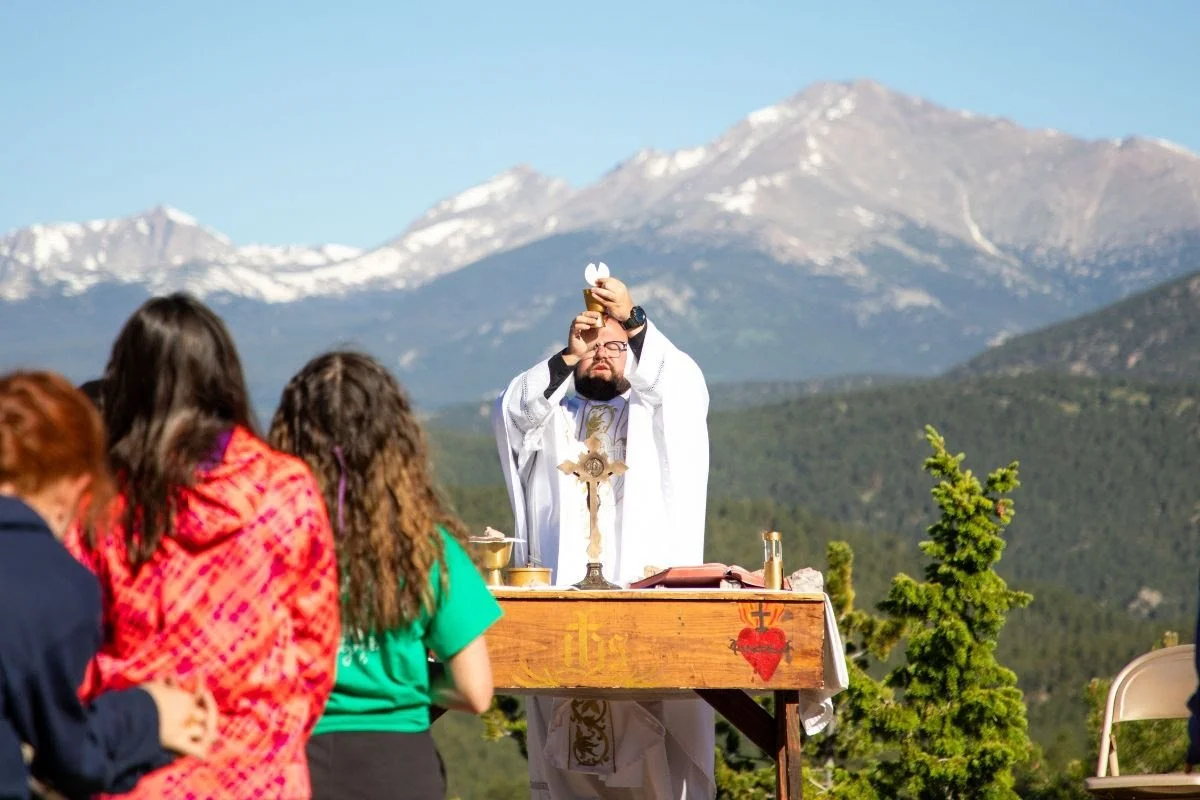
Come to the altar. We were made for this.
Photo from the closing Mass at Camp Wojtyla, June 12th.