
Do You Ever Just Want to Chuck Pears at the Pigs?
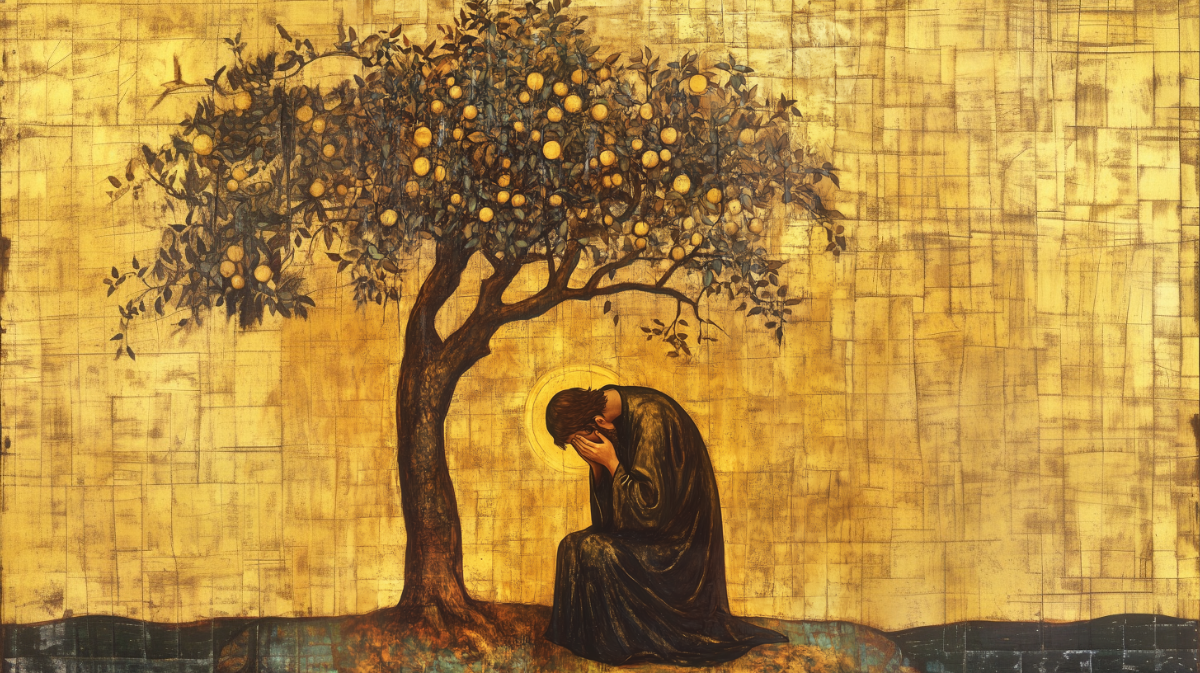
In the opening paragraph of Augustine’s Confessions, he famously writes “our hearts are restless until they rest in you.” The first half of that sentence is so true about who we are, how we work, why sin happens. The second half of the sentence is full of promise and hope. Both halves open up whole worlds to consider and pray about.
Later in the Confessions, Augustine explores that restlessness, including the sinful and dumb things we sometimes do when we can’t sit still, when we can't bear our heart’s aching and yearning. For example, late one night, Augustine and his teenage friends were carousing, and they passed an orchard of pear trees. They hopped the fence to pick and carry off “a huge load of pears.” They weren’t hungry, and he says the pears weren’t even that nice. They ended up taking a few bites and just chucking them at a bunch of pigs. My inner 15 year old thinks trying to bean pigs at midnight sounds kinda fun, but the adult Augustine, looking back, admits it was just the buzz of doing something that wasn’t allowed, the thrill of stealing and doing something forbidden.
In other words, Augustine is trying to describe this weird stubbornness that is part of the human condition. We don’t like to be told what to do, and, in our pride, we sometimes just want to stick it to “the man” and chuck pears at the pigs. My blood runs red, so don’t tread on me. As Americans, we’re marinated and cooked in individualism, independence, and autonomy, so maybe it’s even harder for us. Try and tell me that a chocolate brownie sundae isn’t good for me, and I’m gonna tell you how hungry I am and how much I deserve a treat. Resentment and indignation are cocktails that can go to anyone’s head.
Augustine confesses these things because hopefully, if we can acknowledge this aspect of the human heart, then maybe we can take a breath and be a little less defensive. Problems sometimes get smaller if we can name them, cry about them, laugh at them. In today's scripture, we hear a lot about God’s law and commandments. Maybe if we can step into a space of self-awareness, admitting that rules and laws can get our backs up, maybe we can somewhat dispassionately consider laws and commandments, and keep our inner rebelliousness at arm's length.
So what is it in these scriptures that’s so provocative?
In the first verse of the first reading, Sirach says “if you choose, you can keep the commandments” and “they will save you.” In today’s Psalm, we sang the refrain five times: “Blessed are they who follow the law of the Lord.” In the gospel, Jesus says “do not think that I have come to abolish the law,” but to fulfill it. Jesus reveals the deep inner rationale of the law: you’ve heard it said, don’t kill; I say, don’t nurse your anger. You’ve heard it said don’t commit adultery; I say, stop making excuses for lustful eyes. He keeps going: don’t call it a lawful divorce if it’s a cover story for adultery. Jesus concludes: you’ve heard it said, don’t take a false oath, but I say, skip the technical pleading and be plain-spoken, with a simple yes or no.
In other words, sometimes you’ll hear a Christian say - perhaps with dangerous self-congratulation - “oh yeah, we’re not Jews, we don’t have to follow all those laws.” But law is one of the ways God loves us; his law is one of the ways he tries to show us a sane way to live and navigate the world. Jesus couldn’t be clearer - he’s respecting the law. He never mocks it. It’s more apt to say that he transposes it. “Love and do what you will” is another famous proverb from St. Augustine. And it’s true in a sense, because the Christian way is to be guided by love. But to cultivate a loving heart is the work of a lifetime. To learn how to love takes practice, trial and error, discipline, and, yes, some days, law.
We understand why Augustine threw pears at the pigs. Laws can be a burden. Sometimes Jesus’ harder sayings make us defensive. Sometimes I just can’t take another set of demands. Don’t tread on me. We know the feeling.
The problem is, my rebellions are self-destructive, and most likely, my sin spreads pain all around. The other day, my daughter and I got into a snit at six o’clock in the morning over who deserved to eat the last bagel in our kitchen. She was the better person. She yielded and gave it to me. I ate it, but there was no joy in that bagel. It tasted like shame and ashes.
My 90 year old mom went back to the hospital this week, the third time in three months. She’s got infections, she has heart problems, and sometimes she’s in a lot of pain. She’s talking about what heaven might be like. She asked my dad the other day for assurance that she will be forgiven. She is one of us. Her heart is restless.
When we look at our lives, perhaps we see an arc, a narrative. The teenage Augustine. Middle aged me at breakfast. My mom in the hospital. All of us restless, all of us looking for peace. Can we be forgiven? Is there still time for a fresh start, Lord? Can I rest in thee, Lord?
Praise God for the saints, both the canonized ones, and the ones we notice in ordinary life. They show us what’s possible. Augustine eventually surrendered to God’s grace knocking at his heart. Who is your favorite saint? They all have great come-back stories, moments when they surrender their pride and make a new start. Usually more than once.
Lent starts on Wednesday. Lent is an invitation to start our come-back story. The invitation of Lenten discipline is to try and soften that heart. The gift of Lenten discipline is to lay down a few speed bumps, so we can catch ourselves in moments of temptation. During Lent, when you fast from something, it will be annoying, but we let that painful abstention be the wake-up call, the little intervention to remind ourselves who we really are and want to become. During Lent, when we give alms, when it hurts to give what we treasure to somebody else, we remind ourselves that everything we have is gift and not an entitlement. We grow our patience and generosity. During Lent, when we pray more, when it's timely to go to confession, maybe we can have honest conversations with God about these things.
The Church - the Gospel - never imposes a law. Nobody is going to force us to be a Christian. If we want to be left alone, we can be. The Christian way is just an invitation. How do we reply? Sirach proposes the law can save us if we let it. The Psalmist promises blessed are those who follow it. Jesus says he’s not going to abolish it but fulfill it. It’s all testimony, reminding us how the restless heart can find peace, how to live sanely, how to become radiant like the saints.
On Ash Wednesday, we reply: go ahead, please, put ashes on my forehead, because although I am a sinner, although I sometimes just want to throw pears for the hell of it, at a deeper even more real level, I am trying to lay down my pride. I want to be healed, to be redeemed.